Wes Anderson’s delightfully fantastical The Grand Budapest Hotel, was released in 2014, and is Anderson’s highest grossing feature to date. Stuffed full of dreamscapes tied together by pastel ribbons, witty comedy, and stories within stories, within stories. Based on the popular Austrian writer, Stefan Zweig’s works, Anderson told a fictional yethistorically inspired account of the devastating but inevitable decline of the imaginary institution of The Grand Budapest Hotel in ‘Zubrowka’. The plot of this feature is surrounding an Authors memorial account of a meeting with Zero Moustafa, the previous lobby boy and now owner of The Grand Budapest Hotel (succeeding the eccentric concierge M. Gustave), who shares his story of how he came to own the institution. While discussing some of the socio-spatial paradigms exhibited within this feature, I will also be exploring themes of nostalgia, storytelling, the hotel as a site of contention and the ‘Andersonian’ theme in American cinema.
Author: It is an extremely common mistake. People think the writer’s imagination is always at work, that he’s constantly inventing an endless supply of incidents and episodes; that he simply dreams up his stories out of thin air. In point of fact, the opposite is true. Once the public knows you’re a writer, they bring the characters and events to you. And as long as you maintain your ability to look, and to carefully listen, these stories will continue to… [Author’s Grandson shoots at him with a pellet gun] Author: Stop it! Stop it! Don’t! Don’t do it!… Uh, will continue to seek you out, uh, over your lifetime. To him, who has often told the tales of others, many tales will be told.
Author Scene Quotation (The Grand Budapest Hotel (2014), Wes Anderson)
Author’s Grandson: Sorry.
Author: It’s all right. The incidents that follow were described to me exactly as I present them here, and in a wholly unexpected way.
The introductory scene of the ‘Author’ within this feature, starts with a quote which I believe perfectly sums up the elusive ‘message’ that The Grand Budapest portrays. Now, I wish to use the term ‘message’ loosely. I think that within a lot of film, literature, and the likes, we as problem-solving mammals look for a deeper meaning or appreciation of what the art may mean. My own personal philosophy is that cultural art can hold more than one truth at a time, and the meanings or significance to any individual could be drastically different.
I believe this is a sentiment that Anderson holds himself, given his often-evasive answers to interview questions surrounding details in the feature posed by M. Z. Seitz in The Wes Anderson Collection: The Grand Budapest Hotel (2015). The Grand Budapest itself, treats storytelling as an “inheritance bequeathed to anyone who’s willing to listen, feel, and remember, the repeat the story, with whatever embellishments are necessary to personalise it and make it meansomething to the teller” (Seitz 2015, 22). Indeed, the whole plot is filled with storytelling and themes of inheritance through loyalty over blood. Yet, the strong theme of inheritance through material or emotional means is also contrasted by themes of heart-felt loss, war and eventual ‘ruin’ of The Grand Budapest. The opening storyline of a rise and fall of grand hotels and spas will sound familiar to readers, since it persists in the contemporary popular imagination (Williams 2019).
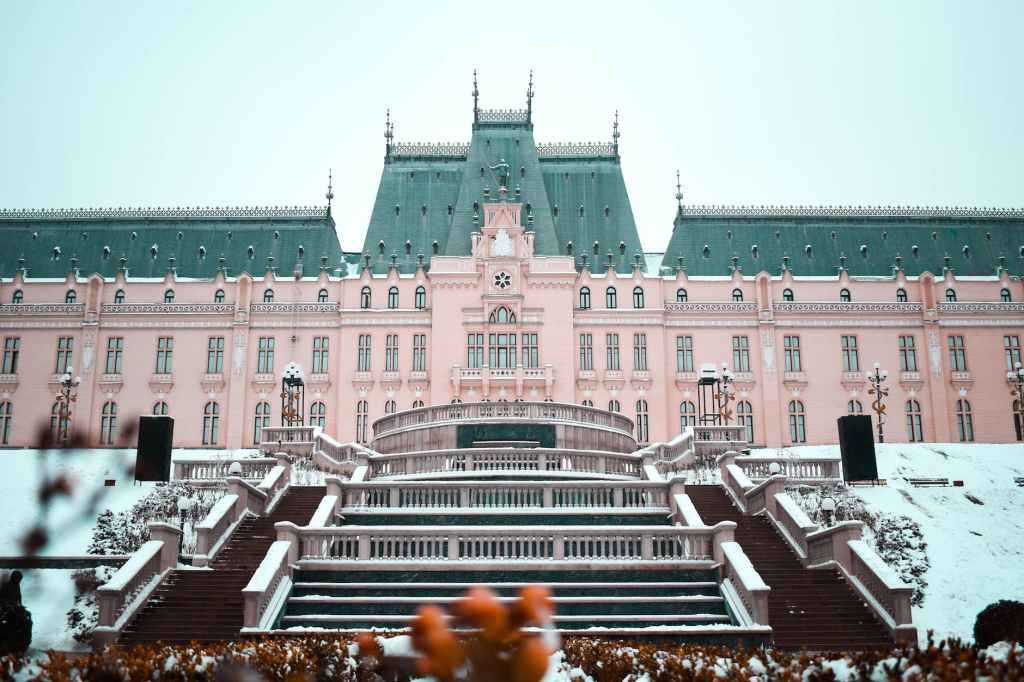
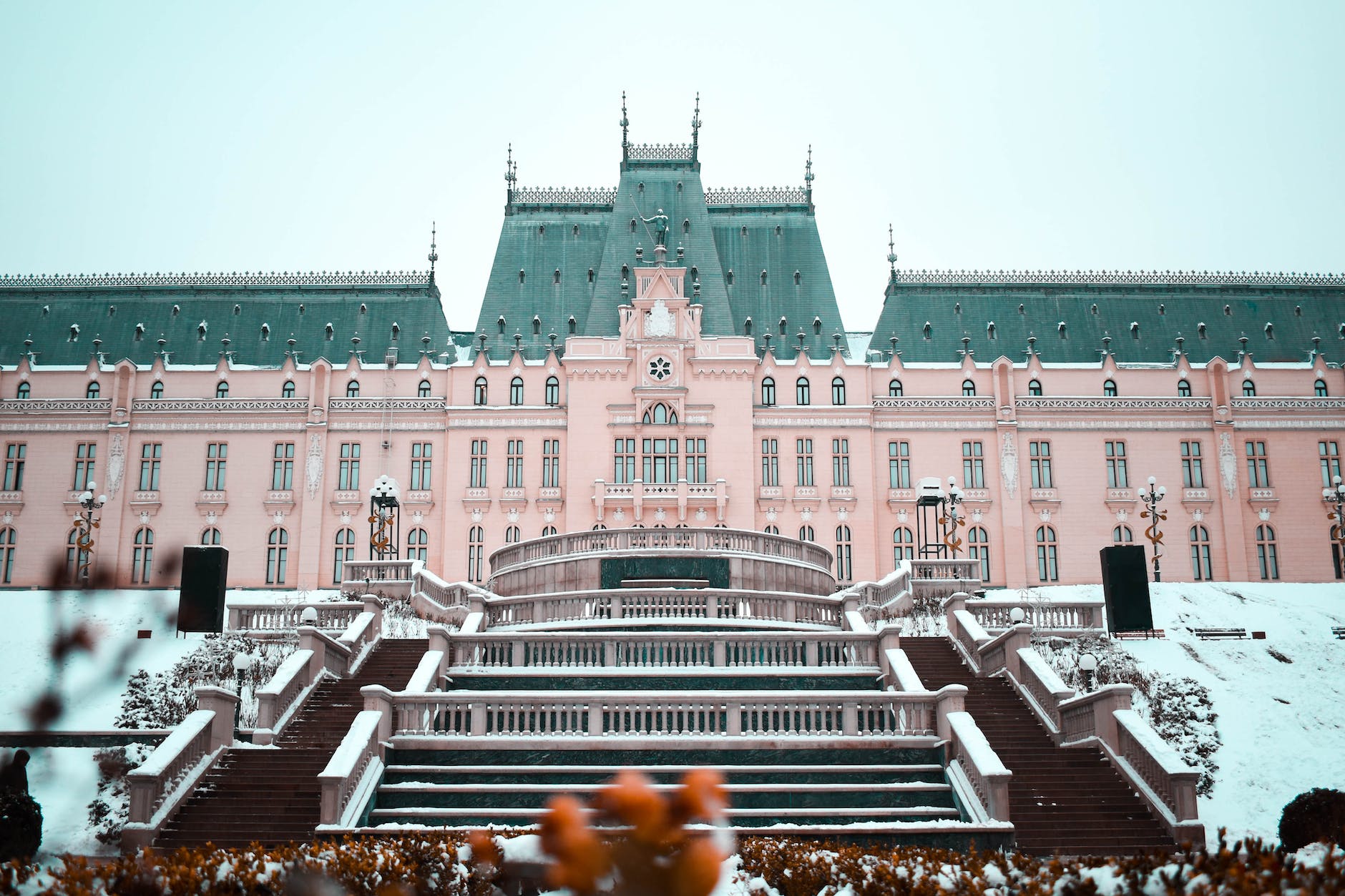
Firstly, to discuss the portrayal of the hotel itself. The grand pink palace sets the scene, with snowy capped mountains and treetops. With the initial design of the set inspired by the grand hotels of central and eastern Europe, the intricate architecture of the building as well as the pink, and purple colour palette evokes a unique, nostalgic aura. The design of these scenes and the art itself produces the ‘mysterious and elating experience known as the ‘sublime’ (Gandy 1996, 3)and Anderson really embodies the ‘harmonious tension between what is perceptually overwhelming and what is nevertheless known to be artifice’ (Gandy 1996, 4) through the design of the hotel and its representation through colour. Not only does this artistic choice for the hotel represent the historic transformation from a deluxe hotel to a hotel under militia. The time periods in which the story is set is not meant to reflect real world happenings, but to be inspired by them, which creates feelings of nostalgia as the plot in the film feels familiar to reality yet is abundant with bright colours and fanciful details. The first period of the story is inspired by Zweig’s “The world of yesterday”, which is before World War I, the second period of the beginnings of war and fascism is depicted with ‘the closing of the frontier’, and then finally there is the period of communism in central/eastern Europe in which the story draws to a close (Seitz 2015, 34). The architectural impact of communism on the hotel is portrayed intensely, with the stark difference in the exterior, interior and colour palette of The Grand Budapest Hotel from the 1930’s period to the fictional ‘soviet era’ of the late 1960’s. Figures are shown below.

1 – Image portraying The Grand Budapest Hotel before the war (The Grand Budapest hotel (2014), Wes Anderson)


2 – Image portraying The Grand Budapest Hotel after the war (The Grand Budapest Hotel (2014), Wes Anderson)
S. M. Williams states in his paper Modern Central European Hotels and Spas in Cultural Criticism: Grand Hotel Nostalgia: An Introduction (2019), that “The Grand Budapest Hotel (2014) harks back to the glory years of grand hotels throughout central Europe…a recent example of cultural nostalgia for the suits and services of a more colourful age” (Williams 2019, 416). Williams then pulls upon the etymology of the word nostalgia, and its indications that it’s context within this ‘cultural phenomenon’ is ultimately misplaced (Williams 2019, 418). He argues that to “feel pain for home cannot define a desire for a return to the great residences of around 1900, if hotels in their supposedly grander days were the counter-sites to domesticity” (ibid.). The hotel as a liminal space, a site of contention and a site of production socio-spatially is an epic interdisciplinary discourse that I would not be able to do justice within this essay alone.
Sherry Simon (2019) argues that ‘The Grand Budapest represents many of the most endearing aspects of the twentieth century European hotel’ (Simon 2019, 47) and though it ventures into the fantastical, it ‘remains attentive to the evidence of history’ (ibid, 50). Simon frames the hotel as a concept, as a ‘site of transit’ where modes of translation are produced through horizontal and vertical trajectories:
“Where the film does not attempt historical accuracy is in the accents and speaking style of its minor actors. The characters playing the criminals who help Monsieur Gustave escape from prison speak in the slang of their own native language: Harvey Keitel, for instance, speaks with an Australian twang. What this does is to introduce an unusual kind of diversity into the film, echoing (through parody) the multilingualism of the spas of Central Europe.” (Sherry Simon 2019, 49)
M. Z. Seitz (2015) reflected on his own personal fascination with “the relationship between the imaginary geography of the film and the real geography of locations and sets” (Seitz 2015, 97). Anderson was extremely successful in blending the fictional story he made with real socio-spatial geographies of architecture, language, and history to fully immerse the audience. Whitney Dilley (2017), similarly to Williams (2019), drew upon the etymology of the word ‘nostalgia’ meaning to ‘return home’. She took the view that Anderson is able to “reproduce, the emotional wonder of a child, as if viewing something for the first time…and this results in his vivid perception of reality in his films that creates a sense of hyper- nostalgia in the viewer” (Dilley 2017, 216). Many of the writers I encountered referenced the ‘child-like pleasures’ that Anderson is able to evoke within his work, and how this creates a sense of nostalgia, pursues fantasy and enriches themes of relationships between child and adult.
“Perhaps, the best way to describe the oedipal aspect of their relationship is to articulate it in terms of history, in terms of a nostalgic and comically chivalrous past that is doomed (obviously associated with Gustav) and a new era of loneliness, angst and guilt, which the old Zero, Mr. Mustafa (F. Murray Abraham), evokes. After all, the very unconcealment of social relations in space stirs up the forces of history of which the militarization of the Grand Budapest Hotel is an obvious metaphor as war in all its enormity sets in. Needless to say, Gustav cannot survive the historical transition that relegates the utopian space of the hotel, whose values he embodies, to a space of decay and shared loneliness.” (Khoshchereh 2015, 163)
M. Khoshchereh (2015) looked at how space within The Grand Budapest Hotel was used to develop social relations and social contention. The quote above shows Khoshchereh’s exploration of the oedipal dimensions across space and time within the actual plot of the feature and within the physical production and directional efforts of Wes Anderson. He based his opinions on the theoretical standpoint given by Henri Lefebvre in which “space is a realm of social activity in which particular paths are invested with “special value”” (Khoshchereh 2015). He argued that at several points within the feature that social power relations exhibited were shifted or broken through exchanging use value for exchange value within the functional spaces shown in the film. For example, the prison break scene created an assumption of continuous space which ‘shattered’ the sense of control that fragmented spaces of prisons are supposed to exert on the prisoners within them (ibid.). In addition to this, the physicality of Anderson’s framing and filming within the feature plays with space and power relations. His unique style of framing his subjects and characters head on and in a symmetrical manner, is contrasted with the flippant and sudden camera panning that constantly shifts the social and power relations within a scene. The enlargement of a snapshot does not only render what was visible as more precise, it reveals entirely new structural formations of the subject (Benjamin 1999, 236).
Vreeland (2015) maintains that “directional style transcends the art of moviemaking in itself” (Vreeland 2015, 35) and Anderson’s directional style is so unique and conscripted to him and himself only, that audiences are able to identify even certain colour-scapes and shooting styles commonly associated with his work. Dilley (2017) added that Anderson has “over time, trained the viewer to gain fluency in [his] unique filmic language” (Dilley 2017, 213). Often, writers have referred to his film style as “Andersonian”, and this ranges from his colour palettes to shooting style and witty, slapstick writing. In the postmodern era where film is generally considered to be representative of social commentary (Vreeland 2015, 36), auteuristic cinema identifies the view of a director as a means of expression – and simply this is what The Grand Budapest Hotel emulates. An exploration of storytelling, inheritance, and loss, through Anderson’s own reflections on Zweig’s writing.
I would like to also spotlight two quotes that I felt complimented each other and offered self-reflection on the meaning of the feature and the philosophical thoughts it provokes:
“Neglecting reality and projecting fantasy.”
(Vreeland 2015, 42)
“Life destroys. Art preserves.”
(Seitz 2015, 22)
Essentially, the two quotes above are expressing the same sentiment from a different angle. Where life destroys, we neglect (or reject?) reality. Where art preserves, we are projecting fantasy. The form of visual media has an incredible role to play across all forms of social commentary, whether it is commercial, academic, leisurely or for activism. Culturally, visual mediums embody and reproduce so many ideologies, histories, and stories. Whether it be for neglecting reality and turning to fantasy for escapism or to portray meanings through fantasy and storying, or to represent real socio-cultural issues and paradigms. For instance, Michael Foucault’s idea of the ‘heterotopia’ is sublimely represented within The Grand Budapest Hotel (Williams 2019). Foucault deems the hotel to be a “social counter-site for ritualistic behaviour, or the limited subversion of cultural convention” (ibid.). This is best shown in Zero’s recount of his memories of M. Gustave:
“I began to realize that many of the hotel’s most valued and distinguished guests came for him. It seemed to be an essential part of his duties… But I believe it was also his pleasure. The requirements were always the same. They had to be rich, old, insecure, vain, superficial, blonde, needy.”
(The Grand Budapest Hotel (2014), Wes Anderson)
This quote describing the types of guests that were in the hotel, and their ultimate desire to be seen by M. Gustave calls attention to the ‘deviance’ that Foucault was referencing in his description of the hotel as a social space. Williams (2019) affirms Foucault’s hints at a reduction in the freer, oppositional social space within the institutionalised society, which is reflected within Anderson’s feature, when seeing the ‘enchanted ruin’ of The Grand Budapest Hotel after the ‘communist’ period is seen empty and lacking the bright and childlike colours that it was before.
The Grand Budapest Hotel ultimately deals with one of the most grotesquely tragic periods within human history through a very clever frame-by-frame structure and childlike wonder that evokes strong feelings of nostalgia, joy, and sadness. Rife with socio-cultural glimpses into the contrasting of past empires of grand hotels and European war, the Andersonian feature has become a landmark in American cinema for its storytelling and aesthetics. There is a great deal more that can be said regarding this brilliant feature’s historical and cultural markers, as well as the general understanding of how film (and the visual) can be used in order to evoke feelings of nostalgia for periods of time that were ‘not all that pretty’…
Bibliography:
- Benjamin, W. 1999 ‘The Work of Art in the Age of Mechanical Reproduction’, in his Illuminations, (Pimlico) pp.211- 244
- Dilley, W. 2017 ‘Memory and Narratives in the works of Wes Anderson’ in The Cinema of Wes Anderson: Bringing Nostalgia to Life
- Gandy, M. 1996 ‘Visions of Darkness: the Representation of Nature in the Films of Werner Herzog’, Cultural Geographies [Ecumene], vol. 3: 1-21
- Khoshchereh, M. 2015 ‘Space as a Field of Social Contention: a Look at Wes Anderson’s Cinema’, Seven Degrees of Independence: Shifting Currents in Alternative American Cinema, p.146.
- Seitz, M. Z. & Washburn, A. 2015 ‘The Wes Anderson Collection: The Grand Budapest Hotel’. New York: Abrams
- Simon, S. 2019 ‘The Hotel as a Translation Site: Plane and Non-place, Difference and Indifference’, Literary Multilingualism, 7
- The Grand Budapest Hotel, 2014 Directed by Wes Anderson, Los Angeles CA, Searchlight Pictures
- Vreeland, A.V. 2015 ‘Color Theory and social structure in the films of Wes Anderson’, Elon Journal of Undergraduate Research in Communications, 6(2), pp.35-44.
- Williams, S.M. 2019 ‘Modern Central European Hotels and Spas in Cultural Criticism: Grand Hotel Nostalgia: An Introduction’, Forum for Modern Language Studies (Vol. 55, No. 4, pp. 415-425). Oxford University Press.
 Kitty Taylor
Leave a comment