
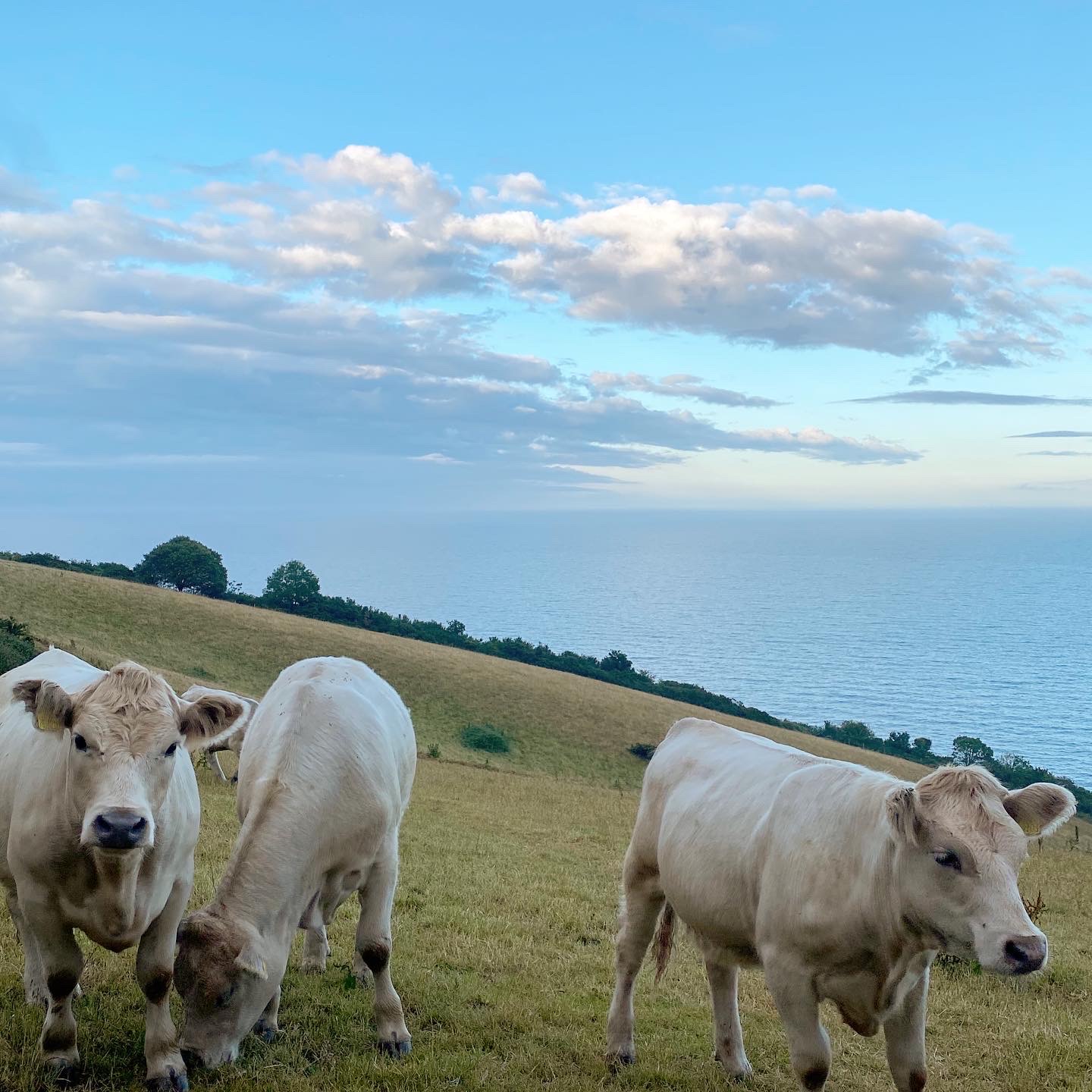
According to the governments summary for the agricultural industry in 2022, 69% of land in the UK is Utilised Arable Area’s (UAA’s) (UK Gov, 2022) , with a fifth of England’s total farmed area being in the South West (The House of Commons Library, 2023). Due to the importance of farms within the UK economically, locally, nationally, environmentally, and socially, there is a wide range of discourses surrounding their place in the national economy, within local communities, in environmental discussions and within topics on nationalism. The South-West is known for its outstanding beauty, and much of Cornwall and Devon specifically are well-beloved summer holiday destinations for those looking to get their fix of the Great British Countryside. Much of this part of the country’s iconic beauty comes from the well-groomed hills and hedgerows that are maintained by the farmers, with a great deal of it being rolling hills for cattle and other grazing livestock. A quick google search would reveal some of the cultural and social attitudes towards farming in Devon, with the results to ‘devon farms’ being made up of ‘farms for sale’ or ‘farm stays’ and ‘farm holidays’. The countryside is a central feature of national symbolism, and rural images often serve as signs of Englishness (Mischi, 2009), and these images create social constructions of place (Wallwork & Dixon, 2004) which are so prominent to not only to the emerging farm tourism sector, but also within local communities’ attitudes to farm shops and businesses. There is a body of literature within psychology and sociology that looks at attitudes and reasonings behind ideologies and images of Englishness or Britishness, but more of this work needs to be explored in geography and I would argue it would be crucial to bolstering research in the agri-tourism sector in the South-West.
Farms within Devon and Cornwall have been needing to adapt and conform to the constraints of climate change, as well as maintaining profit for their businesses within a volatile economic landscape. Geoghegan & Leyson (2012) conducted a series of interviews with farmers on the Lizard Peninsula in Cornwall to explore how climate change is constructed through memory and observation as well as experienced through embodied farming practices. Especially in relation to the topic of climate change (which has increasingly been introduced into the cultural studies field to assess the human impact of climate change thoroughly), place-based identities and the consideration of micro-geographical socio-spatial relations (Geoghegan & Leyson, 2012) across multiple temporalities would be extremely beneficial to foregrounding work in the human relationship to environmental phenomenon such as climate change. Through Geoghegan and Leyson’s interviews they were able to identify three ways in which knowledges of climate change are experienced and constructed by farmers on the Lizard Peninsula; weather and seasons, experiential knowledges, and farming practices.
This convincing paper from Geoghegan and Leyson had me pondering about how we can take theoretical and methodological lessons from work within indigenous geographies to observe and construct ways in which farmers within the South-West experience and relate to issues on climate change. Within an industry that provides food, labour, and money, it is easy to lean into quantifying research and environmental science to identify systematic changes in the field. However, qualitative research that reveals the relational nature of place and identity as something practical and performed as well as represented, and how these constructions of knowledge are observed by farmers and local communities would enrich local case studies and organisations, particularly the University of Exeter Centre for Rural Policy Research. As I mentioned above, similarly to native and indigenous understandings of kinship to land, practices of agriculture, and embodied experiences of landscape and place, how can we as researchers help assess the impact of climate change (and other spatio-economic changes) on British Farmers, organisations and their communities regarding their agri-food practices, and more broadly relational place identity, within the South-West?
It is easy for researchers within the agri-food industry to quantify the prevalence of the industry in the South-West, and how it may or may not be affected by climate change in the future. Yet without full understanding and enrichment of this data through the cultural experiences and creation of these understandings, ideologies, and practices, a critical understanding of how all these systems and humans interact with one another would not be possible, nor ever an accurate one. In the University of Exeter Centre for Rural Policy Research’s report on the Devon Food Economy (Lobley et. al., 2012), they state that Devon’s food economy is ‘larger in relative terms to that of any other English county’, accounting for 13% of GVA in Devon, compared to the average figure which is 7.6%. There are several nuances to these figures though, that make understanding the Devon foodscape no simple task. For instance, most farming businesses in the South-West, and particularly Devon, are dairy farms, and majority are small businesses; Devon also has a high concentration of artisanal food businesses and farm shops that rely on ‘loyal local customers’ and trade on ‘quality and personal connections’ (Lobley et. al., 2012) through farm shops or specialised rural outlets. It is apparent that even through the retail side and local economies, that a cultural exploration of consumer practices would also benefit the understanding of the agri-food sector within the South-West and particularly Devon.
To summarise, its well-known that the agri-food sector and economy across the UK is a diverse landscape, with lots of scope for enriching research and development, particularly in emerging (and perhaps even beneficial) agri-tourism pockets in the South-West. However, more cultural qualitative research that includes interviews, ethnographic data and participatory methods needs to be conducted as the businesses and practices present in this field are ‘more than numbers’, and deep-rooted social experiences and observations can be uncovered through conducting research such as this. In relation to climate change, local community attitudes, rural tourism, ‘Englishness’, and Devon foodscapes, identifying and traversing the poetics of place-based identities and embodied practices is integral to the development of our understanding of this dynamic industry.
Bibliography
Geoghegan, H., Leyson, C., 2012. On climate change and cultural geography: farming on the Lizard Peninsula, Cornwall, UK. Climatic Change, 113, pp.55–66. https://doi.org/10.1007/s10584-012-0417-5
Mischi, J., 2009. Englishness and the countryside: how British rural studies address the issue of national identity. Englishness revisited, pp.109-124.
Wallwork, J. and Dixon, J.A., 2004. Foxes, green fields and Britishness: On the rhetorical construction of place and national identity. British Journal of Social Psychology, 43(1), pp.21-39.
Agriculture in the United Kingdom 2022 – Summary GOV.UK. Available at: https://www.gov.uk/government/statistics/agriculture-in-the-united-kingdom-2022/summary (Accessed: 07 March 2024).
Stewart, I, Coe, S. and Uberoi, E. (2023) Agriculture in the South West. Available at: https://researchbriefings.files.parliament.uk/documents/CBP-9772/CBP-9772.pdf (Accessed: 07 March 2024).
Lobley, M., Thomson, J.T. and Barr, D.A., 2012. A Review of Devon’s Food Economy.
 Kitty Taylor
Leave a comment